
The coffee aisle at your local supermarket looks impressive. Rows of colorful bags from established brands, competitive prices, and the convenience of grabbing coffee while you shop for groceries. Yet many coffee enthusiasts insist that local roasteries are superior. I decided to put this claim to the test.
Over the course of three months, I purchased coffee from both supermarkets and local roasteries. I brewed them using identical methods, tasted them side-by-side, and evaluated them across multiple dimensions. What I discovered challenged some assumptions and confirmed others.
The Supermarket Coffee Experience
Supermarket coffee is convenient. You know what you’re getting, the price is consistent, and the selection is broad. Major brands have invested heavily in marketing and distribution, making them ubiquitous.
But convenience comes with trade-offs.

Most supermarket coffee has been sitting on shelves for weeks or months. The roast date is often not printed on the package, which is itself revealing. When a company is proud of their freshness, they advertise it prominently. The absence of this information suggests the opposite.
The Taste Profile
Supermarket coffee tends toward consistency rather than complexity. The flavor is often described as “bold” or “strong,” which typically means it emphasizes bitter compounds over nuanced flavors. This approach masks the defects common in lower-grade beans.
The roasting is often darker than necessary, which destroys delicate flavor compounds. This creates a product that tastes similar regardless of origin—Ethiopian coffee tastes like Colombian coffee tastes like Brazilian coffee.
The Local Roastery Experience
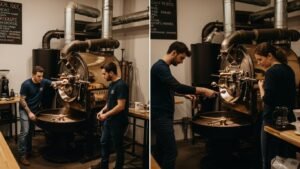
Local roasteries operate on a completely different model. They roast frequently, often daily or several times per week. They maintain direct relationships with farmers or importers. They’re passionate about their work.
Walking into a local roastery is a different experience entirely. You can smell the coffee being roasted. The staff can tell you about the origin, altitude, processing method, and flavor profile of each coffee. They can recommend brewing methods based on your preferences.
The Taste Profile
Local roastery coffee emphasizes the unique characteristics of each origin. Ethiopian coffee tastes distinctly different from Colombian coffee. You can taste the terroir—the environmental factors that shaped the beans.
The roasting is typically lighter, preserving delicate flavor compounds. This requires higher-quality beans to begin with, but the result is coffee with genuine complexity and nuance.
The Price Comparison
This is where many people hesitate. Local roastery coffee typically costs more per pound than supermarket coffee. My testing confirmed this: supermarket coffee averaged $8-10 per pound, while local roastery coffee averaged $12-16 per pound.
However, the value proposition is different. You’re not just paying for coffee—you’re paying for freshness, quality, and expertise.
Brewing Method Impact
To ensure a fair comparison, I brewed both supermarket and local roastery coffee using identical methods: a pour-over with filtered water at 200°F, 30-second bloom, and 3-minute total brew time.
The difference was dramatic. Supermarket coffee produced a cup that was harsh and bitter, with little complexity. Local roastery coffee produced a cup that was smooth, balanced, and interesting.
Freshness Testing
I purchased supermarket coffee and local roastery coffee on the same day, then tested them weekly for four weeks.
The supermarket coffee degraded noticeably after one week. By week three, it tasted stale and flat. The local roastery coffee remained vibrant and flavorful through week three, with only minor degradation by week four.
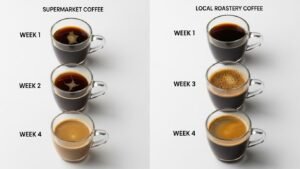
This difference is significant. If you’re buying coffee that will sit for weeks before consumption, you’re starting with a disadvantage.
The Environmental Factor
Local roasteries typically roast in small batches, which reduces waste. They often use sustainable packaging. They maintain relationships with farmers who practice sustainable agriculture.
Supermarket coffee comes from massive industrial operations that prioritize efficiency and cost reduction over environmental considerations.
Understanding Coffee Freshness and Quality
To truly appreciate the difference between supermarket and local roastery coffee, it helps to understand what makes coffee fresh and high-quality. Learning about how coffee bean freshness shapes the entire experience provides insight into why roast date matters so much.
Additionally, understanding the differences between coffees from different regions helps you appreciate why local roasteries emphasize origin information—because it genuinely matters.
The Economics of Local Roasteries
Local roasteries operate on thinner margins than supermarket coffee. They can’t compete on price because they don’t have the economies of scale. What they offer instead is quality, freshness, and expertise.
Many local roasteries also provide educational value. They host cuppings, offer brewing classes, and engage with their customers. This community aspect is something supermarket coffee simply cannot provide.
When Supermarket Coffee Makes Sense
I’m not suggesting supermarket coffee is never acceptable. In certain situations, it makes sense:
Travel and convenience: When you need coffee immediately and have no other options
Bulk brewing: When you’re making large quantities for events
Budget constraints: When price is the primary concern
For everyday consumption, however, the quality difference justifies the additional cost.
Making the Switch
If you’re accustomed to supermarket coffee, switching to local roastery coffee might feel jarring initially. The lighter roast and more delicate flavors are different from what you’re used to.
Exploring easy coffee recipes for everyday life can help you find brewing methods that work well with higher-quality beans. Different brewing methods highlight different aspects of specialty coffee.
The Curious Coffee Traditions Connection
Understanding coffee culture more broadly provides context for why local roasteries matter. Coffee traditions from different countries show how coffee is valued and appreciated globally—and how local roasteries preserve these traditions.
Storage and Longevity
Both supermarket and local roastery coffee should be stored in airtight containers away from light and heat. However, because local roastery coffee is fresher when purchased, it maintains quality longer even with identical storage.
The Verdict
After three months of testing, the conclusion is clear: local roastery coffee is superior to supermarket coffee across nearly every dimension—flavor, freshness, complexity, and sustainability.
The price premium is justified. You’re not paying more for the same product; you’re paying for a genuinely better product.
Making an Informed Choice
The choice between supermarket and local roastery coffee ultimately depends on your priorities. If convenience and cost are paramount, supermarket coffee makes sense. If you value flavor, freshness, and quality, local roasteries are worth the investment.
Most people find that once they’ve experienced truly good coffee from a local roastery, they can’t go back to supermarket coffee. The difference is simply too pronounced.
I recommend visiting your local roastery and asking questions. Tell them about your brewing method and taste preferences. Let them recommend something. Taste it fresh, brewed with care.
Then compare it to your regular supermarket coffee. The difference will speak for itself.

Gabriel James is passionate about the world of coffee, with hands-on experience in specialty beans and artisanal brewing. He has worked in local coffee shops and closely observed extraction and service techniques. Today, he uses this blog to share accessible and relevant tips that help beginners understand and better appreciate coffee in their daily lives. His goal is to make learning simple and inspire more people to explore new flavors and methods.