
In the modern world of high-tech vacuum brewers, pressurized espresso machines, and complex pour-over drippers, there is one device that has remained a constant fixture on the countertops of coffee lovers for nearly a century: the French Press. Known for its heavy body and rich, textured mouthfeel, the French Press is often the first “manual” brewing method people master. But despite its name and its ubiquitous presence in European and American kitchens, the history of this device is a fascinating tale of patents, rivalries, and a constant search for the perfect filter.
Understanding the French Press is about more than just knowing how to push a plunger. It is about appreciating a brewing philosophy that prioritizes oils and sediments over clarity and brightness. When we explore The Science Explains Why Certain Cups Matter, we often talk about how the vessel affects our perception, and the French Press—usually made of glass and stainless steel—offers a visual and tactile ritual that is as satisfying as the drink itself.
The Origins: A French Invention or an Italian Perfection?
The legend of the French Press begins in the mid-1800s in France. Folklore tells of an old man in Provence who, while boiling water over an open fire, forgot to add his coffee. He added the grounds to the boiling water, and to keep them from floating at the top, he used a metal screen and a stick to push the grounds to the bottom. To his surprise, the coffee was better than anything he had ever tasted.
However, the official history is a bit more bureaucratic. The first patent for a device that filtered coffee using a plunger was filed in 1852 by two Frenchmen, Mayer and Delforge. But their design was flawed—it didn’t create a perfect seal against the sides of the carafe, meaning grounds would often escape into the cup.
The “modern” French Press we recognize today was actually perfected by an Italian designer named Attilio Calimani in 1929. Calimani refined the seal using a flexible metal spring around the mesh. Later, in 1958, another designer named Faliero Bondanini patented his own version, which became a sensation in France under the brand name “Melior.” This is why, to this day, the device is often caught in a tug-of-war between French and Italian cultural identity.
The Science of Full Immersion
What makes the French Press unique in the world of coffee is its “Full Immersion” brewing style. Unlike a pour-over or a drip machine, where water passes through the coffee grounds, the French Press allows the grounds to sit in the water for the entire duration of the brew (usually 4 to 5 minutes).
This leads to a more uniform extraction. Because the coffee is not filtered through paper, the natural oils of the bean are not trapped. These oils are responsible for the creamy, velvety texture that French Press fans adore. This is a primary reason Why Some Cheap Coffees Surprise You and Some Expensive Ones Disappoint; a French Press can actually make a simpler, chocolatey coffee taste much more expensive by emphasizing its body and sweetness.
The Grind: The Make-or-Break Variable
If there is one area where people fail with the French Press, it is the grind size. Because the filter is a metal mesh with relatively large holes, you cannot use the “all-purpose” pre-ground coffee found in most supermarkets. That coffee is ground too fine and will pass right through the mesh, leaving you with a cup full of “sludge.”
For a perfect French Press, you need a coarse grind, roughly the consistency of sea salt. This allows the water to extract the flavors slowly without over-extracting the bitter tannins. This technical requirement is one of the many reasons we discuss The Quick Guide to Not Making Mistakes When Buying Coffee for the First Time in the USA—choosing the right grind is the most important step in honoring the history of this method.
The Global Names of the Press
It is a testament to the popularity of this device that it goes by so many different names around the world:
-
France: Cafetière à piston.
-
United Kingdom and Australia: Coffee Plunger.
-
South Africa: Filter Cafetière.
-
New Zealand: Press Pot.
-
USA: French Press.
Despite the different names, the ritual remains the same. It is a slow, communal way of making coffee. Unlike an espresso, which is an individual shot, a French Press is designed to be shared. It is the center of a breakfast table, a conversation starter, and a symbol of taking one’s time in a world that is always in a hurry.
The “James Hoffmann” Revolution: Rethinking the Method
In recent years, the specialty coffee community has seen a resurgence of interest in the French Press, thanks in part to modern baristas like James Hoffmann. The traditional “plunge as soon as the timer hits 4 minutes” method has been updated.
The new “standard” for enthusiasts involves letting the coffee steep for 4 minutes, breaking the “crust” of grounds at the top with a spoon, skimming off the foam and floating bits, and then waiting another 5 to 8 minutes for the fine particles to settle naturally at the bottom. By not plunging all the way down, you avoid disturbing the sediment, resulting in a cup that has all the body of a French Press but the clarity of a filter coffee.
Why the French Press is Still Relevant Today
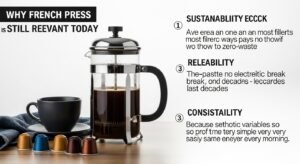
In an era of electronic pods and “smart” coffee makers, the French Press remains relevant for three reasons:
-
Sustainability: It is one of the most eco-friendly ways to brew. There are no paper filters to throw away and no plastic pods to end up in landfills. It is a “zero-waste” brewing method.
-
Reliability: There are no electrical parts to break. A good stainless steel or heavy glass press can last decades. It is the ultimate “off-grid” coffee maker.
-
Consistency: Because the variables are so simple—coffee, water, and time—it is very easy to get the same result every single morning.
The Aesthetics of the Press
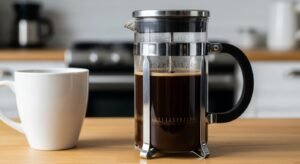
Designers have turned the French Press into a work of art. From the classic chrome-plated Bodum models that defined the 1980s kitchen to the modern, double-walled vacuum-insulated stainless steel versions that keep coffee hot for hours, the device is a statement piece. It represents a specific Caffeinated Lifestyle—one that values mid-century modern aesthetics and functional simplicity.
FAQs About the French Press
-
Why does my French Press coffee taste bitter? This is usually caused by leaving the coffee in the press after you have finished plunging. The “extraction” doesn’t stop just because the plunger is down. Once brewed, you should decant the coffee into a separate carafe.
-
Can I make cold brew in a French Press? Yes! It is actually one of the best tools for it. Simply add coarse grounds and cold water, let it sit on your counter for 16 hours, and plunge.
-
Is the glass carafe safe? Most are made of borosilicate glass, which is resistant to thermal shock. However, you should always pre-warm the glass with hot water before brewing to prevent any risk of cracking.
The French Press is a bridge between the past and the present. It reminds us that coffee doesn’t need to be complicated to be “unforgettable.” It requires only patience, good water, and the right beans. As you press down the plunger tomorrow morning, take a second to remember the 170 years of history and design that led to that perfect, heavy, and comforting cup.

Gabriel James is passionate about the world of coffee, with hands-on experience in specialty beans and artisanal brewing. He has worked in local coffee shops and closely observed extraction and service techniques. Today, he uses this blog to share accessible and relevant tips that help beginners understand and better appreciate coffee in their daily lives. His goal is to make learning simple and inspire more people to explore new flavors and methods.