
For many coffee enthusiasts, the espresso shot is the “Holy Grail” of caffeine. It is the foundation of lattes, cappuccinos, and americanos—a concentrated, syrupy nectar topped with a golden layer of crema. However, there is a common misconception that in order to enjoy a true espresso, you need to spend thousands of dollars on a dual-boiler Italian machine and a high-end commercial grinder.
While professional gear certainly makes the process easier, the truth is that espresso is a principle of physics, not just a specific piece of equipment. By understanding pressure, grind size, and water temperature, you can achieve a remarkably high-quality concentrated brew using affordable manual tools. Whether you are using a Moka pot, an AeroPress, or a manual lever press, the goal is the same: to capture the intensity and complexity of the bean in a small, powerful dose.
The Physics of Espresso: Understanding the “9 Bars”
To technically call a drink “espresso,” water must be forced through a compacted puck of finely ground coffee at approximately 9 bars of pressure. In a professional setting, an electric pump handles this heavy lifting. At home, we have to get creative.
Why is pressure so important? Pressure acts as an emulsifier. It forces the oils from the coffee beans to mix with the water in a way that standard gravity brewing (like a drip machine) simply cannot. This emulsion is what creates the “body” of the coffee and the iconic crema. When we explore The Difference Between Good and Unforgettable in the Coffee You Buy, we are often talking about the texture that only pressure can provide. Without it, you are just drinking very strong coffee, not espresso.
Method 1: The Moka Pot (The Italian Soul)
The Moka pot, or stovetop espresso maker, is found in almost every household in Italy. While it technically only reaches about 1.5 to 2 bars of pressure—not quite the 9 bars required for “true” espresso—it produces a concentrated, heavy-bodied brew that is the closest most people will get to a cafe experience without an electric machine.
The Secret to Success: Most people make the mistake of putting the Moka pot on high heat with cold water. This “cooks” the grounds before the water even reaches them, leading to a burnt, metallic taste. Instead, try this:
-
Boil your water first: Fill the bottom chamber with already-boiling water. This reduces the time the coffee sits on the stove.
-
Don’t tamp: Unlike a real espresso machine, do not pack the coffee down tightly. The Moka pot doesn’t have enough pressure to push through a hard puck, and it might explode or result in a bitter mess.
-
The Cold Towel Trick: As soon as the coffee starts to gurgle and turn a light honey color, remove it from the heat and wrap the bottom in a cold, wet towel. This stops the extraction immediately and prevents the “over-boiled” bitter flavors from entering your cup.
This attention to detail is what separates a morning habit from a culinary experience, much like Why Some Cheap Coffees Surprise You and Some Expensive Ones Disappoint. It’s often about the technique, not just the price of the pot.
Method 2: The AeroPress (The Modern Hack)
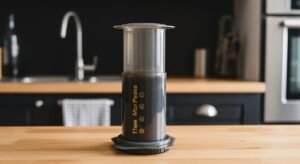
The AeroPress is perhaps the most versatile tool in a coffee lover’s arsenal. While it is primarily a filter coffee maker, the “Fellow Prismo” attachment or the “Joepresso” can help create enough back-pressure to mimic an espresso shot.
By using a very fine grind and a metal filter, the AeroPress allows you to use your own body weight to create pressure. It won’t give you a thick, persistent crema, but it will give you the concentration needed for a perfect home-made latte. It is a favorite for those who value the “science” of brewing, as it allows you to control every single variable, from water temperature to steep time.

The Grind: Your Most Important Ingredient
Regardless of the tool you use, your espresso will fail if your grind is wrong. Espresso requires a fine, consistent grind—finer than table salt but not quite as powdery as flour. If the grind is too coarse, the water will fly through it, resulting in a sour, watery liquid. If it is too fine, the water will clog, and the result will be painfully bitter.
This is why having a high-quality grinder is more important than the brewer itself. If you are using a cheap blade grinder, you will never achieve the uniformity needed for a balanced shot. The quest for the right grind size is a journey every enthusiast must take, and it is often The Day I Discovered My Favorite Coffee Flavor—not because I found a new bean, but because I finally matched the grind to the method.
Water Quality: The 98% Rule
Because espresso is so concentrated, the quality of your water is magnified. If your tap water has a high chlorine content or is “hard” (full of minerals like calcium), your espresso will taste flat or chalky.
Professional cafes use expensive reverse-osmosis systems with remineralization. At home, simply using a basic charcoal filter pitcher can make a world of difference. You want water that is clean and neutral so that the natural acids and oils of the bean can take center stage.
The Freshness Factor (The 15-Day Rule)
Espresso is notoriously unforgiving when it comes to old beans. To get that beautiful crema, the beans must be fresh. Crema is actually a foam of CO2 bubbles trapped in coffee oils. As beans age, they lose their CO2.
Ideally, you should use beans that were roasted between 7 and 21 days ago. Beans that are “too fresh” (less than 5 days) will be too bubbly and unstable, while beans older than a month will be “dead,” producing a thin, dark liquid with no foam. This is why checking the “Roast Date” on the bag is a non-negotiable step for any serious home barista.
Troubleshooting Your Home Shot
If your home espresso tastes “off,” look at the color and the time:
-
Too Sour? Your water was likely too cold, or your grind was too coarse. The water moved too fast and didn’t pull out the sweetness.
-
Too Bitter? You probably used boiling water or the grind was so fine that the water stayed in contact with the coffee for too long.
-
No Crema? Your beans are likely old, or you didn’t use enough pressure.
The Ritual of the “Fake-spresso”
While the purists might call these methods “concentrated coffee” rather than “espresso,” the result in your cup is what matters. There is a profound satisfaction in mastering a manual tool. It connects you to the history of the beverage.
When you finally dial in that perfect shot on your stovetop or manual press, you aren’t just making a drink; you are engaging in a craft that spans centuries. It requires patience, observation, and a willingness to fail a few times before getting it right. But once you taste that rich, velvety shot made in your own kitchen, the local coffee shop will have a hard time competing.
FAQs About Home Espresso
-
Can I use “Espresso Roast” beans for regular drip coffee? Yes! “Espresso Roast” is just a label roasters use to suggest the bean has a profile that tastes good when concentrated (usually lower acidity and more sweetness). You can brew it any way you like.
-
Does more pressure mean better coffee? Not necessarily. While 9 bars is the standard, some modern “turbo shots” are pulled at 6 bars to highlight fruitier notes. However, you need at least some pressure to get the characteristic texture.
-
How do I froth milk at home without a steam wand? You can use a French Press! Just pour warm milk into the press and pump the plunger up and down rapidly for 30 seconds. It creates a surprisingly creamy micro-foam perfect for lattes.
Mastering espresso at home is a marathon, not a sprint. Start with the tools you have, focus on the quality of your beans and the precision of your grind, and soon you’ll be pulling shots that rival the best cafes in the world.

Gabriel James is passionate about the world of coffee, with hands-on experience in specialty beans and artisanal brewing. He has worked in local coffee shops and closely observed extraction and service techniques. Today, he uses this blog to share accessible and relevant tips that help beginners understand and better appreciate coffee in their daily lives. His goal is to make learning simple and inspire more people to explore new flavors and methods.