
For most coffee lovers, the grind size is a single, crucial variable: too coarse, and the coffee is weak and sour; too fine, and it’s bitter and over-extracted. We spend countless hours dialing in our grinders to find that perfect, uniform particle size that promises a balanced cup. But what if the secret to a truly extraordinary, complex, and layered flavor profile wasn’t uniformity, but deliberate duality? This is the philosophy behind the “Dual Grind” technique, a method that challenges conventional wisdom by intentionally combining two distinct grind sizes—one fine, one coarse—in a single brew. The result is a cup that captures the best of both worlds: the body and sweetness from the finer particles, and the clarity and bright acidity from the coarser ones, creating a flavor experience that is anything but ordinary.
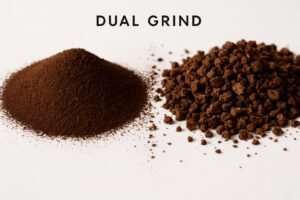
The concept might sound counter-intuitive, bordering on heresy for purists, but it’s rooted in the science of extraction. Finer particles have a larger surface area, leading to faster extraction of soluble compounds, primarily responsible for body and sweetness. Coarser particles, with less surface area, extract slower, yielding the more delicate, acidic, and complex flavor notes. By mixing them, you are essentially performing a controlled, simultaneous dual extraction. The finer grind ensures you hit the necessary extraction yield for a satisfying strength and mouthfeel, while the coarser grind acts as a filter and a slow-release capsule for the more volatile, nuanced flavors. This controlled chaos allows you to layer flavors in a way a single, uniform grind simply cannot, giving your coffee a depth and complexity that mimics the best blends.
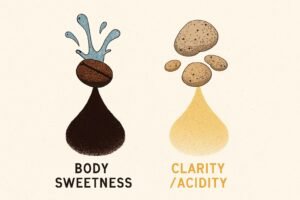
The Science of Dual Extraction
To execute the Dual Grind successfully, you must understand the role of each particle size. The **fine grind** (often set for espresso or Turkish coffee) is your body and sweetness booster. It quickly releases the sugars and oils, giving the coffee its satisfying weight and richness. The **coarse grind** (similar to French Press or Cold Brew) is your clarity and complexity enhancer. It extracts slowly, preventing the harsh bitterness that would come from over-extracting the fine particles, and instead, it allows the delicate fruit and floral notes to shine through. The magic happens in the ratio. A good starting point is a 70/30 split: 70% of your total coffee dose at your standard pour-over grind, and 30% at a much finer setting. This ratio can be adjusted based on the bean’s roast level and origin. For a lighter roast, you might increase the coarse portion to emphasize acidity. For a darker roast, you might increase the fine portion to boost body and mask any potential bitterness.
The Method: How to Perform the Dance
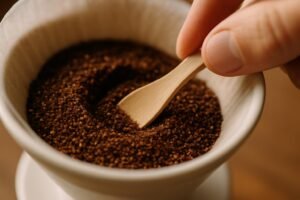
The process is surprisingly simple, requiring only two steps beyond your normal routine. First, weigh your total dose of beans. Second, divide the beans according to your chosen ratio (e.g., 21g for the standard grind, 9g for the fine grind, for a 30g total dose). Grind each portion separately. The key is to mix the two grinds thoroughly just before brewing. This ensures that the water interacts with both particle sizes simultaneously and evenly. When brewing, a slow, controlled pour is essential. The mixed bed of coffee grounds will have a different permeability than a uniform one, so you may need to adjust your pour speed to maintain a consistent flow rate. This technique works particularly well with pour-over methods like the V60 or Chemex, where you have maximum control over the water flow. For a deeper dive into how different brewing methods affect the final cup, you might find our article on Fast and Slow Coffee Brewing Methods insightful.
Beyond the Basics: Advanced Dual Grind
Once you master the basic 70/30 split, you can begin to experiment with more advanced applications. One popular variation is the “Turbo Grind,” where a very small percentage (5-10%) of the dose is ground to an extremely fine, almost flour-like consistency. This micro-fine powder acts as a ‘flavor bomb,’ dramatically increasing the body and sweetness without significantly impacting the overall extraction time. Another technique is to use the Dual Grind to compensate for less-than-ideal beans. If you have a bean that is slightly stale or a roast that is too light, the Dual Grind can help you coax out more flavor and body than a single grind could. It’s a testament to the fact that the brewer’s skill can often overcome the limitations of the raw material. This level of precision, controlling every variable from grind to temperature, is what separates a good cup from a truly exceptional one, a topic we touched upon in our guide to Precision Coffee.
The Flavor Profile: A Symphony in a Cup
The most compelling reason to embrace the Dual Grind is the unique flavor profile it creates. You get a cup with a rich, velvety body—a characteristic often associated with French Press or espresso—combined with the clean, bright, and complex acidity typical of a V60. Imagine the deep chocolate notes of a darker roast dancing with the vibrant berry acidity of a light Ethiopian Yirgacheffe. The Dual Grind makes this flavor layering possible, delivering a symphony of tastes that evolve as the coffee cools. It’s a technique that rewards the adventurous brewer, transforming the daily ritual into an exciting exploration of flavor possibilities. It proves that sometimes, breaking the rules is the only way to truly elevate your coffee game.


Gabriel James is passionate about the world of coffee, with hands-on experience in specialty beans and artisanal brewing. He has worked in local coffee shops and closely observed extraction and service techniques. Today, he uses this blog to share accessible and relevant tips that help beginners understand and better appreciate coffee in their daily lives. His goal is to make learning simple and inspire more people to explore new flavors and methods.