
When we talk about the secrets of a world-class cup of coffee, we almost always focus on the beans. we talk about the roast profile, the specific hillside in Ethiopia where the cherries were picked, or the precision of the burr grinder sitting on the counter. But there is a glaring oversight in most home brewing setups: the water. A cup of coffee is approximately 98% to 99% water. If you are using subpar water, you are essentially trying to paint a masterpiece on a dirty, crumbling canvas.
In the United States, tap water quality varies drastically from one city to another. Some regions have “soft” water that lacks character, while others have “hard” water so full of minerals that it clogs up machines and makes coffee taste like chalk. If you have ever wondered Why Some Cheap Coffees Surprise You and Some Expensive Ones Disappoint, the answer might not be in the bag of beans at all—it might be flowing right out of your kitchen faucet. To truly unlock the “unforgettable” notes of a specialty bean, we have to look at the chemistry of the water we use to extract it.
The Chemistry of Extraction: Water as a Solvent
Coffee brewing is, at its core, a chemical extraction. Hot water acts as a solvent, pulling soluble compounds—oils, acids, sugars, and caffeine—out of the ground coffee cells. However, water is not a “neutral” player in this game. The minerals already present in your water determine which flavors get pulled out of the coffee and which ones stay trapped in the grounds.
The two most important minerals in coffee water are Magnesium and Calcium.
-
Magnesium: This is the “flavor extractor.” Magnesium ions are very “sticky” when it comes to oxygen-rich compounds like the bright, fruity acids found in light roasts. If your water has a healthy amount of magnesium, your coffee will taste vibrant and complex.
-
Calcium: This mineral helps with the “body” and the heavier, chocolatey notes. However, too much calcium leads to limescale buildup in your kettle and can make the coffee taste dull or “heavy” in an unpleasant way.
This delicate balance is why The Science Explains Why Certain Cups Matter, but the water inside that cup is doing the heavy lifting before the liquid even touches your lips.
The Problem with Tap Water: Chlorine and Contaminants
Even if your tap water has the perfect mineral balance, it likely contains something that is a total deal-breaker for coffee: Chlorine. Municipalities add chlorine to keep water safe from bacteria, but even in tiny amounts, chlorine reacts with the phenols in coffee to create “chlorophenols.” This results in a medicinal, chemical, or “pool-like” aftertaste that can ruin even the most expensive Geisha beans.
Beyond chlorine, tap water often contains sediments, rust from old pipes, and varying levels of fluoride. These don’t just affect the taste; they hide the delicate aromatics. When you are paying a premium for a single-origin bean with “notes of jasmine,” you won’t be able to smell or taste those notes if the water is fighting against them with a chemical odor of its own.
Hard Water vs. Soft Water: Finding the Middle Ground
In the coffee world, we often talk about “Total Dissolved Solids” (TDS). This is a measurement of how much “stuff” is in your water.
-
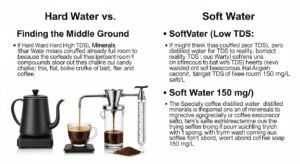
Hard Water (High TDS): If your water is very hard, it is already “full” of minerals. Because it is so crowded, it has less “room” to pull the flavors out of the coffee. This often leads to a flat, bitter, and chalky cup.
-
Soft Water (Low TDS): You might think that pure, distilled water (zero TDS) would be the best. In reality, it’s the worst. Distilled water is “too empty.” Because it lacks minerals to grab onto the coffee compounds, it results in an aggressively sour and salty extraction. It’s like trying to wash a car with a sponge that won’t absorb any soap.
The Specialty Coffee Association (SCA) suggests a “target” TDS of around 150 mg/L. This provides enough mineral “muscle” to extract the good stuff without being so crowded that it makes the coffee bitter.
How to Fix Your Water at Home
Most people don’t have a laboratory in their kitchen, but there are three practical ways to improve your water quality immediately:
1. The Carbon Filter Pitcher (The Basic Step) A standard Brita or similar pitcher uses activated carbon to remove chlorine and some sediments. This is the bare minimum for any coffee lover. It won’t significantly change the mineral content (hardness), but it will remove the chemical smells that mask the coffee’s aroma.
2. Third Wave Water and Remineralization (The Enthusiast Step) A popular trend in the US specialty scene is using distilled or Reverse Osmosis (RO) water and adding a packet of specific minerals back in. Products like “Third Wave Water” contain a precise blend of magnesium, calcium, and potassium. This ensures that every time you brew, your water is identical to the water used by professional baristas. This consistency is key to understanding The Difference Between Good and Unforgettable in the Coffee You Buy.
3. Under-Sink RO Systems (The Professional Step) For those who brew a lot of coffee or have an expensive espresso machine, an under-sink Reverse Osmosis system with a remineralization cartridge is the ultimate solution. It protects your equipment from scale and provides a perfect, neutral base for every cup.
The Role of Bicarbonate (Alkalinity)
There is one more “hidden” player in water chemistry: Bicarbonate. This acts as a buffer for acidity. If your water has too much bicarbonate, it will neutralize all the bright, fruity acids in your coffee, leaving it tasting like “brown water” or tobacco. If it has too little, the coffee will taste sharp and vinegary.
This is why some people find that their coffee tastes amazing in one city and terrible in another, even using the same equipment and beans. The alkalinity of the local water is essentially “editing” the flavor of the coffee.
Temperature: The Final Variable
Once you have the right water, you have to use it at the right temperature. For a long time, the rule was “never use boiling water.” While it’s true that 212°F (100°C) can be too harsh for some dark roasts, many light roasts actually benefit from water that is just off the boil (around 205°F).
Water temperature affects the speed of extraction. Hotter water extracts faster. If your water is too cool (below 190°F), you will fail to extract the sugars, resulting in a thin, sour brew. Finding the “sweet spot” for your specific water and bean combination is part of the ritual of the Caffeinated Lifestyle.
Practical Advice for the Home Barista
If you want to test if your water is the problem, try this simple experiment: Buy a gallon of “Spring Water” from the store (not distilled, but spring water like Crystal Geyser or Volvic). Brew a cup of your favorite coffee with your tap water and another cup with the bottled spring water. The difference is often so dramatic that it will change how you view coffee forever.
Once you realize that water is an ingredient, not just a medium, you will stop blaming the roaster for a “bitter” bag of beans and start looking at the chemistry in your kettle.
FAQs About Coffee Water
-
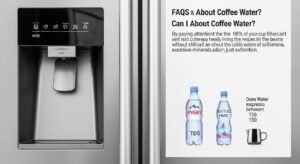
Can I use water from my fridge dispenser? Most fridge filters are just basic carbon filters. They help with chlorine but won’t fix hard water issues. It’s better than nothing, but not ideal for specialty coffee.
-
Is bottled water always good for coffee? No. Some bottled waters (like Evian) are extremely hard and will make coffee taste dull. Look for bottled waters with a TDS between 50 and 150 for the best results.
-
Does water quality affect the crema in espresso? Absolutely. The mineral content affects the surface tension of the water, which directly impacts how the CO2 bubbles form the crema. Harder water often results in a more stable but less flavorful crema.
By paying attention to the 98% of your cup that isn’t coffee, you are finally giving the beans the respect they deserve. You are allowing the hard work of the farmer and the roaster to shine through without the interference of chlorine or excessive minerals. Great coffee starts with great water—everything else is just extraction.

Gabriel James is passionate about the world of coffee, with hands-on experience in specialty beans and artisanal brewing. He has worked in local coffee shops and closely observed extraction and service techniques. Today, he uses this blog to share accessible and relevant tips that help beginners understand and better appreciate coffee in their daily lives. His goal is to make learning simple and inspire more people to explore new flavors and methods.