
There’s a peculiar ritual that happens in American tourist shops, airport gift stores, and souvenir stands across the country. Visitors walk in, browse the shelves, and inevitably find themselves drawn to the same item: a mug with the city’s name printed on it. Some have skylines. Some have landmarks. Some are just simple text with a date. Yet somehow, these mugs have become one of the most collected items in American travel culture. The question isn’t whether you’ll find city mugs—it’s how many you’ll end up buying.
This obsession is real.
Walk into the home of almost any American who travels, and you’ll likely find a shelf or cabinet dedicated to mugs from different cities. New York. San Francisco. New Orleans. Denver. Seattle. The collection grows with each trip, each mug a physical reminder of a place visited, a memory captured in ceramic. But why? Why has the city mug become such an iconic part of American travel culture? The answer reveals something interesting about how Americans relate to travel, memory, and everyday objects.
The History of the City Mug
City mugs aren’t a recent invention. They’ve been around for decades, evolving from a simple souvenir into a cultural phenomenon. In the mid-20th century, when travel became more accessible to average Americans, the need for affordable, portable souvenirs grew. City mugs fit perfectly into this niche. They were inexpensive, easy to transport, and served a practical purpose once you got home.
The beauty of the city mug is its simplicity.
Unlike more elaborate souvenirs—statues, decorative plates, or regional crafts—a city mug is functional. You don’t have to display it awkwardly on a shelf. You can actually use it. You can drink your morning coffee from a mug that reminds you of a trip to Boston or a weekend in Austin. This practicality is part of what makes city mugs so appealing. They’re not just decorative—they’re useful.
As travel became more common and tourism industries grew, city mugs became standardized. Nearly every tourist destination now has its own version. The designs vary, but the concept remains the same: a mug that says “I was here.”
The Psychology of the Mug Collection
Collecting city mugs taps into something deeper than just wanting a souvenir. It’s about creating a visual record of your travels. Each mug represents a place, a time, and an experience. When you look at your collection, you’re not just seeing mugs—you’re seeing a map of your life.
This is particularly powerful for people who travel frequently.
For business travelers, tourists, and adventure seekers, the mug collection becomes a way to make sense of all the places they’ve been. It’s easy to lose track of cities visited, experiences had, and people met when you’re constantly on the move. The mug collection provides a tangible anchor. It’s a way of saying, “I was in all these places. These experiences happened to me.”
There’s also an element of identity in the collection. The mugs you choose to display—or the ones you choose to use regularly—say something about your personality and your travel history. A collection heavy on West Coast cities suggests someone who travels west frequently. A mix of international and domestic mugs suggests a well-traveled person. The collection becomes a form of self-expression.
The Ritual of the Purchase
There’s a specific ritual that surrounds buying a city mug. You arrive in a new city, and at some point during your visit, you find yourself in a gift shop or tourist store. You browse the shelves, looking at mugs with the city’s name in various fonts and designs. You might pick up several, comparing them, deciding which one best represents the city or which design appeals to you most.
The decision is surprisingly difficult.
You want the mug to be special. You want it to capture something essential about the city. A generic mug with just the city name feels too simple. A mug with a famous landmark feels more authentic. A mug with a local coffee roaster’s name feels more personal. You’re not just buying a mug—you’re selecting a representation of your experience in that city.
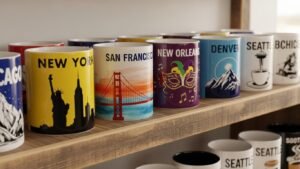
Once you’ve made your selection, there’s a moment of satisfaction. You’ve found the right mug. You’ve captured the essence of your trip in a single object. This ritual has become so ingrained in American travel culture that many people feel like their trip isn’t complete until they’ve bought a city mug.
The Display and the Story
City mugs are meant to be seen. Most people don’t hide their collections in cupboards. They display them prominently on shelves, in cabinets, or on kitchen counters. The collection becomes a conversation starter. Visitors notice the mugs and ask about them. “Oh, you’ve been to Denver? What was it like?” The mug becomes a gateway to sharing travel stories.
This is where the real value lies.
The mug itself is just ceramic. But what it represents—the memory, the experience, the story—that’s what matters. When someone asks about a mug from a city you’ve visited, you get to relive that experience. You get to tell the story of what made that trip special. The mug is just the physical trigger for the memory.
This is why people often keep mugs from trips they didn’t particularly enjoy. The mug isn’t about whether the trip was perfect. It’s about the fact that the trip happened. It’s a record of your life and your travels. Even a mediocre trip to a city produces a mug worth keeping, because the mug represents the experience of being there, of exploring, of stepping outside your normal routine.
The Trend That’s Conquering the USA
In recent years, the city mug trend has evolved. What was once a simple souvenir has become more sophisticated. Coffee roasters in different cities now create their own branded mugs. Local artists design city-specific mugs with unique artwork. The mug market has become more diverse and more competitive. The new coffee trend that’s conquering the USA has even influenced mug design, with specialty coffee shops creating limited-edition mugs that become collectible items.
The quality has improved significantly.
Where city mugs used to be cheap, flimsy souvenirs, many are now high-quality ceramic or stoneware. They’re designed to last. They’re designed to be used regularly, not just displayed. This shift reflects a broader change in how Americans view souvenirs. They want something that’s both meaningful and functional.

The price point has also changed. While you can still find cheap city mugs for five or ten dollars, there’s now a market for premium city mugs that cost twenty, thirty, or even fifty dollars. These premium mugs often feature local artists, unique designs, or special materials. They’re not just souvenirs—they’re art objects.
The Practical Considerations
One of the reasons city mugs have become so popular is purely practical. When you’re traveling, you need to bring something home. Clothes take up luggage space. Food spoils. Decorative items are fragile. But a mug? A mug is durable, compact, and easy to pack. It’s the perfect souvenir for the practical traveler.
This practicality extends to the home.
Unlike many souvenirs that end up in storage or donation piles, city mugs get used. You drink coffee from them. You use them for tea. You use them for hot chocolate. They’re not taking up valuable shelf space—they’re part of your daily routine. This functionality is a big part of why the city mug has become such a dominant souvenir.
There’s also the consideration of cost. City mugs are affordable. Even if you’re traveling on a tight budget, you can usually find a decent city mug for under ten dollars. This affordability means you can buy multiple mugs without breaking the bank. You can build a collection without significant financial investment.
The Checklist Approach to Coffee Shopping
As people become more interested in coffee quality and coffee culture, the way they approach city mugs has changed. Some collectors now use a simple checklist to choose better coffee at the store, and they apply similar thinking to choosing city mugs. They look for quality, design, and authenticity. They prefer mugs from local coffee roasters or local artists over generic tourist shop mugs.
This has created a hierarchy in city mug collecting.
There are the casual collectors who grab any mug from a gift shop. There are the serious collectors who seek out mugs from specific coffee roasters or local artisans. There are the completists who want a mug from every city they’ve ever visited. Each approach reflects a different relationship with travel and collecting.
The Digital Age and the Mug Collection
In an age of Instagram and digital documentation, you might expect the city mug to become less relevant. After all, you can take a photo of any landmark and share it instantly. Why buy a physical mug? But the opposite has happened. The city mug has become more popular, not less.
This is because the mug serves a different purpose than a photo.
A photo is ephemeral. It exists in the digital cloud, competing with thousands of other images for attention. A mug is physical. It’s tangible. It sits on your shelf or in your cabinet, a constant reminder of the place you visited. In a world of increasing digital abstraction, the mug represents something real and concrete.

The mug also serves as a form of analog social media. When someone visits your home and sees your mug collection, they’re learning about you. They’re seeing where you’ve been, what places matter to you, and how you document your travels. The collection tells a story that no Instagram feed ever could.
Why It Matters
The obsession with collecting city mugs might seem trivial, but it reveals something important about American culture and human nature. We want to remember where we’ve been. We want to document our experiences. We want objects that connect us to places and times in our lives. The city mug is a simple, practical way to do all of these things.
It’s a small object with big meaning.
Every mug in a collection represents a journey, a decision to travel, a moment of stepping outside the ordinary. The collection grows over time, becoming a visual representation of a life lived in motion, of curiosity satisfied, of places explored. If you’ve ever stood in front of a shelf of city mugs and felt a wave of nostalgia wash over you, remembering each trip and each place, then you understand why this strange obsession exists. The mug isn’t just ceramic and glaze—it’s a time machine. It’s a memory keeper. It’s a small, practical way of saying, “I was there. This place mattered to me.”

Gabriel James is passionate about the world of coffee, with hands-on experience in specialty beans and artisanal brewing. He has worked in local coffee shops and closely observed extraction and service techniques. Today, he uses this blog to share accessible and relevant tips that help beginners understand and better appreciate coffee in their daily lives. His goal is to make learning simple and inspire more people to explore new flavors and methods.