
For the dedicated coffee enthusiast, the journey to the perfect cup often begins not with the brewing method, but with the grind. It is a truth universally acknowledged among baristas that a consistent, uniform grind is the single most important factor in extracting the best flavor from your beans. Yet, when a home brewer decides to upgrade from pre-ground coffee, they are immediately faced with a fundamental choice that can feel overwhelming: the battle between burr grinders and blade grinders. This decision is far more critical than choosing a brewing device, as the grinder dictates the very foundation of your coffee’s flavor profile. A poor grind leads to uneven extraction, resulting in a cup that is simultaneously sour (under-extracted) and bitter (over-extracted). Understanding the mechanics and the resulting particle distribution of each type is the first step in mastering your morning ritual.
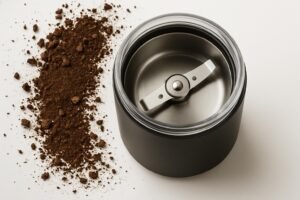
The ubiquitous blade grinder, often found in kitchen cabinets and mistakenly called a “coffee grinder,” operates more like a food processor. It uses a rapidly spinning metal blade to chop the beans into smaller pieces. The appeal is obvious: they are inexpensive, compact, and easy to use. However, their fundamental flaw lies in their inability to produce a uniform particle size. The chopping action creates a wide range of sizes, from fine powder (fines) to large chunks (boulders). This inconsistency is the enemy of good coffee. When hot water hits this mixed-size coffee bed, the fines over-extract quickly, releasing bitter compounds, while the boulders under-extract, leaving behind sour, underdeveloped flavors. The result is a muddy, unpredictable cup that never truly shines. This method is a compromise, sacrificing quality for convenience and cost, and is often the first bottleneck a serious coffee lover must address.
The Precision of the Burr Grinder: The Professional’s Choice
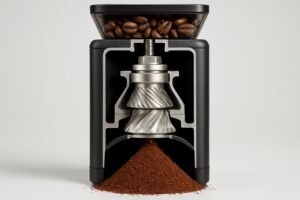
The burr grinder, by contrast, is the gold standard for a reason. It works by crushing the beans between two abrasive surfaces, or burrs. These burrs can be either conical (cone-shaped) or flat, but the principle remains the same: they shear the coffee beans into a remarkably consistent size. This consistency is the key to achieving a balanced, clean, and repeatable extraction. When all the coffee particles are the same size, they release their flavor compounds at the same rate, allowing you to precisely control the brewing process. The difference in taste is immediate and profound, transforming a decent cup into an exceptional one. While burr grinders require a higher initial investment, they are an essential tool for anyone serious about specialty coffee. They offer a range of adjustable settings, allowing you to dial in the perfect grind size for any brewing method, from the coarse grind needed for a French Press to the fine powder required for espresso.
The two main types of burr grinders are conical and flat. Conical burrs feature two cone-shaped rings that fit one inside the other. They are generally quieter, produce less static, and are often preferred for home use due to their efficiency and lower retention of ground coffee. Flat burrs, on the other hand, consist of two parallel rings with teeth. They are known for producing an incredibly uniform particle size, often favored by professional baristas for their ability to deliver a very clean, bright cup profile. The choice between the two often comes down to personal preference and budget, but both are vastly superior to any blade grinder. For those who are still exploring the world of coffee, a simple, quality conical burr grinder is the best starting point. It provides the necessary consistency without the complexity or cost of a high-end flat burr model. This precision is what allows you to truly taste the unique characteristics of your coffee beans, a concept we explored in detail in our article on The Coffee That Changes Flavor As You Drink It.
The Hidden Cost of the Blade Grinder
Beyond the inconsistent particle size, blade grinders introduce another significant problem: heat. The friction generated by the high-speed blade can heat the coffee beans during the grinding process. Heat is detrimental to coffee flavor, as it causes volatile aromatic compounds to dissipate before the coffee even hits the water. This pre-brew degradation means you are losing a significant portion of the subtle, complex notes that make specialty coffee so enjoyable. Furthermore, the lack of control means you are always guessing. There is no reliable way to set a specific grind size; the fineness is determined solely by how long you hold the button down, making it impossible to replicate a successful brew. This lack of control is a stark contrast to the meticulous process of adjusting variables we discussed in Simple Methods That Make Coffee Much More Flavorful.
Making the Right Investment
If you are serious about elevating your coffee experience, the decision is clear: invest in a burr grinder. While a blade grinder might seem like a cost-effective solution, it is ultimately a barrier to quality. It will prevent you from ever achieving the full potential of your coffee beans, regardless of how expensive your beans or brewing equipment are. A quality burr grinder is the single most impactful upgrade you can make to your home coffee setup. It is the foundation upon which all great coffee is built, providing the consistency, control, and flavor preservation necessary for a truly exceptional cup. Don’t let a small, inexpensive tool compromise your entire coffee ritual. Invest in precision, and your taste buds will thank you.


Gabriel James is passionate about the world of coffee, with hands-on experience in specialty beans and artisanal brewing. He has worked in local coffee shops and closely observed extraction and service techniques. Today, he uses this blog to share accessible and relevant tips that help beginners understand and better appreciate coffee in their daily lives. His goal is to make learning simple and inspire more people to explore new flavors and methods.