
For years, I chased the perfect cup of coffee. I bought the expensive beans, the fancy pour-over equipment, and the burr grinder that cost more than my first car. Yet, something was always missing. My coffee was good, yes, but it lacked that *spark*, that vibrant clarity I tasted at my favorite specialty coffee shop. I was convinced the baristas had some secret, proprietary technique, or perhaps access to a mythical water source. It turns out, the secret wasn’t in a new piece of gear or a rare bean; it was in a single, tiny adjustment to the process I already used. This adjustment is so simple, so counter-intuitive, that most home brewers overlook it entirely. It’s a subtle shift that acts like a magnifying glass for your coffee’s flavor profile, revealing notes of citrus, floral sweetness, and deep chocolate that you never knew were hiding in your favorite bag of beans. It’s the difference between listening to a song on a tinny speaker and hearing it live in a concert hall.

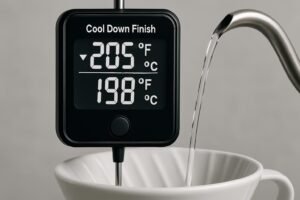
The adjustment? It’s all about the **final water temperature** and the timing of the pour. Most coffee guides will tell you to use water between 195°F and 205°F (90°C to 96°C) and to maintain that temperature throughout the entire brew. This is solid advice for a *standard* extraction, but it often leads to a cup that is slightly muted, with the delicate, complex flavors being overpowered by the more dominant, sometimes bitter, compounds. The secret lies in dropping the temperature of the final pour by a mere **5 to 7 degrees Fahrenheit** (about 3 to 4 degrees Celsius). This small, seemingly insignificant change has a profound impact on the final extraction phase, where the most soluble and often most bitter compounds are released. By cooling the water slightly at the end, you selectively halt the extraction of those undesirable elements, leaving behind a cleaner, sweeter, and far more nuanced cup.
The Science of Selective Extraction: Why a Few Degrees Matter
To understand why this works, we need a quick dive into the chemistry of coffee extraction. Coffee grounds contain thousands of compounds, which dissolve in water at different rates and temperatures. The desirable compounds—the acids, sugars, and melanoidins that give coffee its pleasant flavor and aroma—are highly soluble and extract relatively quickly, especially at higher temperatures. However, the less desirable, more bitter compounds, such as certain polyphenols, are less soluble and tend to extract later in the brewing process, often requiring a slightly longer exposure to high heat. When you maintain a high temperature (say, 205°F) for the entire 3-4 minute brew time, you risk over-extracting these bitter compounds, which then mask the delicate, fruity, or floral notes you paid a premium for. The small temperature drop at the end is a strategic move: it allows the desirable flavors to fully develop while gently shutting down the extraction of the bitter ones. It’s a precision tool for flavor control.
The Technique: Implementing the “Cool Down Finish”
Implementing this technique is surprisingly easy, but it requires a temperature-controlled kettle and a timer. Here is the step-by-step process for a standard pour-over (e.g., V60 or Chemex):
- **Initial Setup:** Grind your beans to a medium-fine consistency. Use a 1:15 coffee-to-water ratio (e.g., 20g coffee to 300g water).
- **The Bloom (0:00 – 0:45):** Heat your water to the standard **205°F (96°C)**. Pour twice the amount of water as coffee (40g) over the grounds to saturate them. Let it bloom for 45 seconds.
- **The Main Pour (0:45 – 1:30):** Continue pouring the water, aiming for a total of 150g by the 1:30 mark. Maintain the 205°F temperature. This is the phase where the bulk of the flavor is extracted.
- **The Adjustment (1:30 – 2:00):** Here is the secret step. **Turn off your kettle or remove it from the heat source.** Allow the water temperature to naturally drop by 5 to 7 degrees. This usually takes about 30 seconds. If you have a kettle with a precise temperature hold, simply lower the setting to **198°F (92°C)**.
- **The Finishing Pour (2:00 – 3:30):** Resume pouring the remaining water (150g) at the lower temperature. The cooler water will complete the extraction, pulling out the remaining sugars and acids without the risk of bitterness. The total brew time should finish around 3:30.
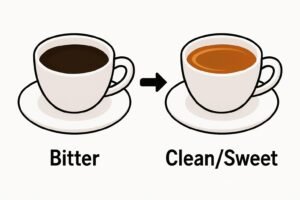
This method, which we can call the “Cool Down Finish,” is a testament to the fact that the pursuit of coffee perfection is a game of millimeters and seconds. It’s a direct application of the principles of control and variable adjustment that we explored in our detailed guide on Precision Coffee: How to Adjust Seconds, Grams, and Temperature to Create Your Exclusive Flavor Signature. The difference in the cup is astonishing. The bitterness is gone, replaced by a clean, sweet finish that highlights the unique characteristics of the bean.
The Grind: The Unsung Hero of This Adjustment
While the temperature adjustment is the star of this technique, it is utterly dependent on a consistent and correct grind. Think of the grind size as the surface area for extraction. If your grind is inconsistent, with a mix of fine dust and coarse chunks, the extraction will be uneven. The fine particles will over-extract and become bitter, while the coarse particles will under-extract and taste sour. This unevenness will completely negate the benefits of the “Cool Down Finish.” The precise temperature control is designed to work with a uniform particle size, ensuring that every single piece of coffee is extracted to the same degree. If you are using a blade grinder, you are essentially gambling with your coffee’s flavor. A quality burr grinder is not a luxury; it is a fundamental requirement for any serious home brewing technique, especially one that relies on such fine-tuned control. We strongly recommend reviewing our comprehensive article on The Ultimate Guide to Coffee Grinders: Burr vs. Blade to ensure your foundation is solid before attempting this advanced technique.
Troubleshooting and Fine-Tuning Your New Recipe
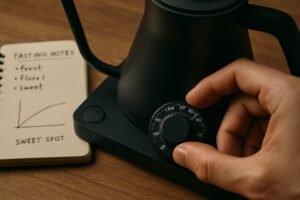
Like any precision technique, the “Cool Down Finish” requires a bit of practice and fine-tuning to match your specific beans and equipment. If your coffee still tastes slightly bitter, try dropping the final temperature by an additional degree or two, or shorten the time of the high-temperature pour. If it tastes weak or sour, increase the final temperature slightly or extend the high-temperature pour. The key is to change only one variable at a time and meticulously record your results. This process of systematic experimentation is what turns a simple recipe into your own signature brew. The goal is to find the “sweet spot” where the extraction is complete, but the bitterness is held back. This small adjustment is a gateway to a whole new world of flavor, proving that sometimes, the biggest revelations come from the smallest changes. It’s a secret that should be shared, turning every coffee lover into their own master barista.

Gabriel James is passionate about the world of coffee, with hands-on experience in specialty beans and artisanal brewing. He has worked in local coffee shops and closely observed extraction and service techniques. Today, he uses this blog to share accessible and relevant tips that help beginners understand and better appreciate coffee in their daily lives. His goal is to make learning simple and inspire more people to explore new flavors and methods.